Tyre pressure seems simple – pump them up and you’re done, right? Actually, getting your tyre pressures correct is more nuanced than many drivers realise. The right pressure depends on your vehicle, how you’re using it, and even the weather conditions.
Running incorrect tyre pressures costs you money in fuel, wears your tyres faster, and in extreme cases can be dangerous. Let’s look at how to get it right.
Where to Find Your Recommended Tyre Pressure
Every vehicle has manufacturer-recommended tyre pressures, but they’re not always easy to find. The most common locations are on a sticker inside the driver’s door frame, inside the fuel filler flap, or in the vehicle handbook.
The door pillar sticker usually shows pressures for front and rear tyres, often with different values for each. It might also show different pressures for different load conditions, which we’ll come to shortly.
Don’t guess or use “standard” pressures. A small hatchback and a large SUV have completely different requirements. Using the wrong pressure, even by 5-10 PSI, affects your car’s handling, efficiency, and tyre wear.
If you’ve genuinely lost all documentation and there’s no sticker, your vehicle manufacturer’s website or a main dealer can provide the correct pressures for your specific model and tyre size.
Understanding PSI and BAR Measurements
Tyre pressure is measured in either PSI (pounds per square inch) or BAR. UK petrol station pumps usually show both, but it’s worth understanding the relationship.
One BAR equals approximately 14.5 PSI. So a tyre inflated to 2.0 BAR is roughly 29 PSI, while 2.5 BAR is about 36 PSI. Most car tyres run between 28-35 PSI or 1.9-2.4 BAR.
Some older British cars might show recommended pressures in PSI only, while European cars often use BAR. Make sure you’re reading the right measurement on the pump to avoid over or under-inflation.
Adjusting Pressure for Passenger Load
This is where many drivers go wrong. Your recommended tyre pressure often changes depending on how many passengers you’re carrying and how much luggage you have loaded.
The door pillar sticker typically shows two sets of pressures: one for normal use (driver plus one or two passengers) and higher pressures for fully loaded conditions (all seats occupied plus luggage).
For example, a typical family car might specify 32 PSI front and rear for normal use, but 35 PSI front and 38 PSI rear when fully loaded. That rear pressure increase is crucial when you’ve got four adults and a boot full of holiday luggage.
Loading the car without increasing tyre pressure causes excessive flexing in the sidewalls, generates more heat, and increases the risk of tyre failure. It also makes the car handle poorly and uses more fuel.
When to Use Higher Pressures
Beyond passenger load, there are other situations where higher pressures are recommended. Motorway journeys, especially sustained high-speed driving, benefit from slightly increased pressure to reduce heat buildup.
Some manufacturers recommend adding 2-3 PSI for extended motorway use. This reduces rolling resistance and helps prevent the tyres from overheating during continuous high-speed driving.
If you’re towing a caravan or trailer, you’ll almost certainly need increased rear tyre pressures. Check your vehicle handbook for specific towing pressures, as these can be significantly higher than normal driving pressures.
Never exceed the maximum pressure shown on the tyre sidewall, but within that limit, following the manufacturer’s load-adjusted recommendations is essential for safety and tyre longevity.
Seasonal Pressure Changes
Tyre pressure changes with temperature. As the weather gets colder, the air inside your tyres contracts and pressure drops. In hot weather, pressure increases.
A general rule is that tyre pressure changes by about 1 PSI for every 10°C temperature change. So if you inflate your tyres to 32 PSI in summer when it’s 25°C, they might read only 29 PSI on a winter morning at -5°C.
This means you should check and adjust pressures seasonally. When winter arrives in South Yorkshire and temperatures drop, your tyres probably need topping up even if they were fine in September.
Similarly, don’t be alarmed if your pressures read higher than expected on a hot day after a motorway run. The tyres heat up during use, which temporarily increases pressure. Always check pressures when tyres are cold for accurate readings.
The Importance of Checking When Cold
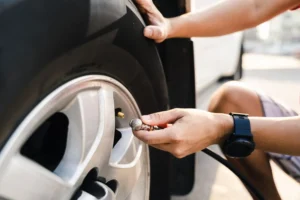
Speaking of cold tyres, this is a crucial point many people miss. Tyre pressure should always be checked and set when the tyres are cold – meaning the car hasn’t been driven for at least two hours.
Driving heats up the tyres, increasing the pressure by 3-5 PSI or more depending on conditions. If you check pressures after driving to the petrol station, you’ll get a false reading and likely under-inflate when the tyres cool down again.
Ideally, check pressures at home before you drive anywhere. If you must check at a petrol station, drive there gently and check immediately upon arrival rather than filling up first and checking afterwards.
Front vs Rear Pressure Differences
You’ll notice that recommended front and rear pressures are often different. This reflects the different loads and weight distribution on each axle.
Front-wheel-drive cars typically have higher front pressures because the engine weight sits over the front axle. Rear-wheel-drive cars might have more balanced pressures or even higher rears depending on the design.
Never just inflate all four tyres to the same pressure unless that’s specifically what your manufacturer recommends. The front-rear difference is there for good reasons related to handling, wear patterns, and load distribution.
Consequences of Incorrect Pressure
Under-inflation is the most common problem. Tyres running 20% below recommended pressure wear faster on the outer edges, generate excessive heat, and increase fuel consumption by up to 3%.
Severely under-inflated tyres can fail catastrophically, especially at motorway speeds or when heavily loaded. The sidewalls flex too much, overheat, and can separate from the tread.
Over-inflation causes the centre of the tread to wear faster than the edges. The ride becomes harsh and uncomfortable, and the reduced contact patch affects grip, especially in wet conditions.
Both under and over-inflation reduce your tyres’ lifespan. Getting pressures right can add thousands of miles to your tyres and save you significant money over time.
Special Considerations for Run-Flat Tyres
If your car has run-flat tyres, maintaining correct pressure is even more critical. Run-flats rely on reinforced sidewalls to support the vehicle if pressure is lost, but they still need to be inflated correctly for normal use.
Run-flat tyres often require slightly higher pressures than standard tyres. Check your vehicle’s specific recommendations rather than assuming they’re the same as regular tyres.
Many cars with run-flats have TPMS (Tyre Pressure Monitoring Systems) as standard. Don’t rely solely on this to alert you to pressure problems. Regular manual checks are still important as TPMS typically only warns when pressure has dropped significantly.
How Often Should You Check Tyre Pressure?
Monthly checks are the minimum recommendation. Set a reminder on your phone for the first of each month if that helps you remember.
You should also check before any long journey, especially if you’re loading the car heavily or driving a significant motorway distance. The few minutes spent checking could prevent a breakdown or accident.
After hitting a pothole or kerb, check your pressures. Impact damage can cause slow leaks that aren’t immediately obvious but will leave you under-inflated within a few days.
If one tyre consistently loses pressure between checks, even just a few PSI, get it inspected professionally. A slow puncture or valve problem needs addressing before it becomes an emergency.
Nitrogen vs Regular Air
Some tyre services offer nitrogen inflation instead of regular air. Nitrogen molecules are larger and escape through the rubber more slowly, so pressure remains stable for longer.
For normal road use, the benefit is marginal. Racing teams use nitrogen because it’s also less affected by temperature changes, but for your daily commute around Barnsley, regular air is perfectly adequate.
If your tyres are already inflated with nitrogen, you can still top up with regular air in an emergency. The mixture won’t cause problems, though you’ll lose some of nitrogen’s benefits.
Getting Help with Tyre Pressure Management
If you’re unsure about correct pressures for your specific usage, or if you’re struggling to maintain stable pressures, professional help is available.
Mobile tyre services can check your pressures, identify any slow leaks, and ensure your tyres are correctly inflated for your driving conditions. We carry proper calibrated gauges and can spot issues that aren’t obvious to untrained eyes.
DC Emergency Tyre Fitting provides tyre pressure checks and adjustments as part of our mobile service across Barnsley, Rotherham, Sheffield, Doncaster, and Wakefield. We’ll ensure your tyres are correctly inflated and identify any underlying problems before they leave you stranded.